Before the First Biscuit: A Pre-Booking Checklist for Group Dog Classes
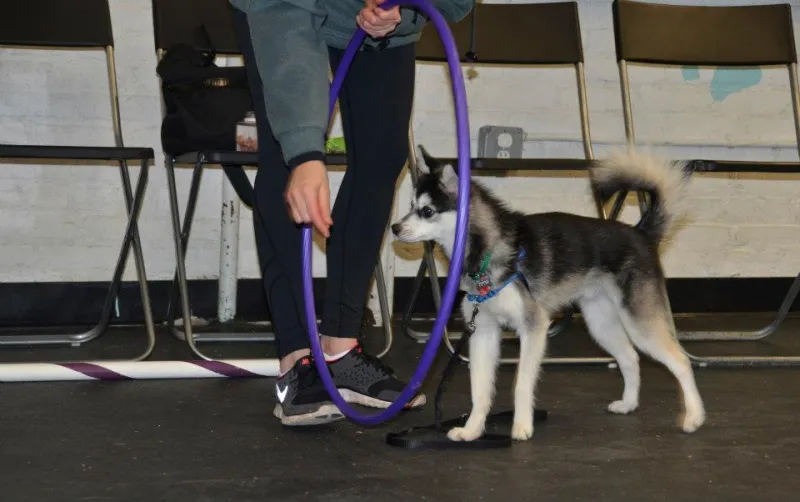
Photo: Andrea Arden, CC BY 2.0, via Wikimedia Commons
There is a particular smell to a village hall on a Tuesday evening. Floor polish, wet coats, and a faint tang of liver cake. If you have been to one dog class, you might assume you have been to them all. You have not.
Two classes can run out of near-identical halls, twenty minutes apart, and be utterly different propositions: one a calm, well-drilled hour where six dogs and their owners actually learn something; the other a chaotic scrum where a dozen dogs bark at each other for fifty minutes and everyone goes home frazzled, dog and human alike.
The difference is rarely the building. It is the structure, the numbers, and the questions nobody asked before paying. So here is a checklist worth running through before you book — not to catch anyone out, but because a good trainer will be pleased you asked.
Start with what the class asks you
Before you get to your questions, notice theirs. A well-run class wants to know your dog's age, breed, neuter status, vaccination record, and — crucially — whether there have been any reactivity issues, bites, or scary incidents. They will want to know how your dog copes with other dogs at a distance, not just how handsome they are.
If enrolment is a single "pay here" button and nothing else, that is information in itself. A trainer who takes bookings without any screening is either planning to keep the class extremely small, or has not thought it through.
"Socialisation" is a word to interrogate
You will see it on almost every class description. It has come to mean everything and nothing. What it should mean in a class context is controlled, low-pressure exposure: walking past other dogs at a distance, settling on a mat while life happens nearby, learning that other dogs are background rather than something to charge at.
What it should not mean is twenty minutes of free-for-all play in a confined space. Endless off-lead play is not socialisation; for a lot of dogs it teaches the opposite lesson, that the sight of another dog is a standing invitation to barrel over. A bit of structured play between well-matched dogs can be fine, but it should be an occasional bonus, not the headline act.
Seven questions worth asking
1. How many dogs, and how many humans running it? Ask for the maximum number in the class, not the average. Six to eight dogs with one trainer plus an assistant is a decent ratio for a beginner class. Twelve dogs in a church hall with one person and a clicker is a crowd control exercise with treats.
2. What happens when a dog has a wobbly moment? Every class has one. The answer tells you a lot. A good trainer has a plan — screens, a partition, a space to work at the edge of the room, a calm exit — and will not make a drama of it. If the answer is a vague "we just manage it", press a little further.
3. What are the trainer's qualifications, and can I check them? Ask which body they are accredited with — the APDT, the IMDT, the Pet Professional Guild, or the Animal Behaviour and Training Council register. Then actually look. In England, dog trainers are not licensed the way boarding kennels and day care are, so a framed certificate is not the same as an accountable one.
4. What will my dog be able to do by week six? A specific answer — loose-lead walking past a distraction, a settle on a mat, a recall to a hand touch — is a good sign. "A happier, more confident dog" is lovely, but it is not a curriculum.
5. Is there any off-lead work? For most beginner classes the answer should be no, or only in a securely fenced space with dogs matched by size and play style. If off-lead is standard in an open hall, ask who is supervising and how dogs are separated when it goes sideways.
6. What is the policy on vaccinations and refunds? Most classes ask for proof of vaccination, and some accept current titre results — either is reasonable. Ask what happens if your dog comes into season, picks up a bug, or the trainer cancels a week. A written policy suggests a business that has done this before.
7. Can I come and watch a session first? Many trainers allow it; some do not, and for good reason — a strange human in the room can unsettle the dogs. If a visit is not possible, ask for a short video of a real session, or at least a phone call. A trainer who will not talk to you before taking your money is one to think twice about.
The question to ask yourself
Is your dog actually ready for a group? Classes suit dogs who can cope with other dogs at a distance and recover from a fright within a minute or two. If your dog is shutting down, lunging at the end of the lead, or cannot take a treat in the car park, one-to-one work first is the kinder route — and plenty of trainers will say so if you ask honestly.
Little things that make a difference
Practical details worth checking: is the floor slippery? Laminate and polished wood are hard work for a dog trying to hold a settle. Is there parking, or is it a permit zone? Is the room warm enough in January and breathable in July? And what should you bring — usually a mat, a pile of small soft treats, a flat collar or harness, and a lead that is not a retractable one.
Fees in 2026 tend to sit somewhere between £10 and £18 per session for a local class, or £70 to £140 for a six-week block, depending on the area and the trainer's experience. Cheap is not automatically bad and expensive is not automatically good — the ratio, the structure, and the trainer's willingness to answer questions matter far more than the price tag.
The short version
A good class is quiet, structured, and slightly boring in the best way. Dogs spend most of the hour working near each other, not on top of each other. The trainer knows your dog's name by week two and has a plan for the one who finds it all a bit much.
Ask the questions. The right trainer will not mind — and the wrong one will have told you everything you need to know.