The Engine's Off, the Dog's Still In: A Winter Errand Reality Check
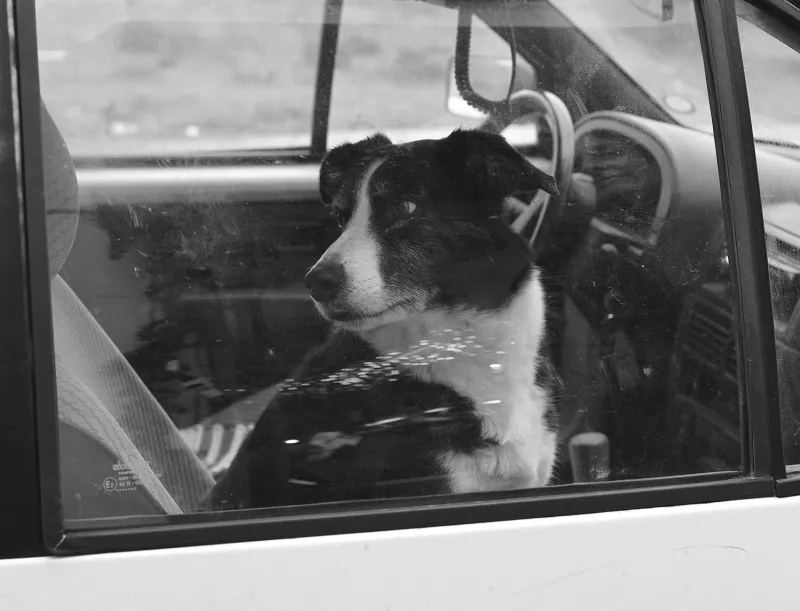
It is 3:40pm on a Saturday in November. The car park is grey, the windscreen is misting up, and the queue in the shop is longer than the sign promised. You look back at the car. The dog looks back at you. Someone says, 'He'll be fine — it's cold out.' That is exactly the sentence this article is about.
Cold is not the same as safe
A parked car in winter is not a neutral box. It is a metal shell that holds whatever the weather is doing, plus whatever your dog is doing inside it. Cold air settles. Damp coats stay damp. A thin-coated whippet, a puppy, an older dog with stiff joints or a dog who is already anxious will feel the chill faster than a hardy collie who thinks sleet is a personality trait.
And cold is only one part of it. A dog left in a car is also left with no water, no toilet option, no escape from noise, and no way to tell you they have had enough. The five-minute errand has a habit of becoming twelve minutes when the till queue backs up, the pharmacy is short-staffed, or you bump into someone from school. 'Just five minutes' is rarely measured in minutes. It is measured in distractions.
Then there is the bit nobody likes to think about: dog theft. A dog alone in a car is a visible, accessible dog. Add festive crowds, dark afternoons and busy car parks, and the risk goes up, not down.
What the law actually says in the UK
There is no blanket law that says 'thou shalt not leave a dog in a car'. The law is broader and, in some ways, more serious. In England and Wales, the Animal Welfare Act 2006 places a duty on anyone responsible for an animal to meet its needs. If a dog is left in a car in a way that causes unnecessary suffering — whether from cold, heat, distress or lack of water — that can be an offence. Scotland and Northern Ireland have their own equivalent welfare legislation.
In practice, that means the question is not 'is it allowed?' but 'is the dog actually okay?' A cold car with a shivering puppy in it is not okay. A car with a dog who is barking, pawing at the window or curled into a tight ball is not okay. If you see a dog in distress in a parked car, call 999 and ask for the police. If the dog is not in immediate danger but you are concerned, note the registration, stay nearby and contact the RSPCA or the local authority. Do not put yourself at risk, and do not break a window unless it is genuinely a last resort and the dog is in immediate danger.
A simple decision tree for winter errands
Ask these in order, and be honest with yourself.
- Is the dog coming inside with me for the whole stop? If yes, carry on. If no, go to question two.
- Will I be out of sight for more than a couple of minutes? If yes, the dog stays home. That is the whole plan.
- Is it cold, wet or windy — or is the dog small, thin-coated, elderly, poorly or a puppy? If yes, the dog stays home. Colder weather makes the car a worse waiting room, not a better one.
- Is there a genuinely dog-friendly shop, café or waiting area where the dog can stay with me? If yes, and your dog is comfortable in busy places, take them. If not, home.
- Is someone staying in the car with the dog? Even then, think hard. You would not leave the engine running unattended, and a cold car with a human in it is still a cold car. A short walk together beats a long wait apart.
If you are already out and the plan has fallen apart, cut the errand short. Go home. Come back another day. The shop will still be there.
Warning signs if you spot a dog in a car
In cold weather, watch for shivering, hunched posture, lifted paws, lethargy, curling into a tight ball, whining, or a dog who seems unable to settle. In any weather, distress looks like panting, drooling, barking, scratching at the glass, or a dog who appears collapsed or unresponsive. Cold cars can also fog up quickly, which makes it harder for the dog to be seen and harder for you to assess them.
If the dog is in immediate danger, call 999. If you are not sure, call the RSPCA cruelty line or the local council animal welfare team and describe what you can see. Stay nearby if it is safe to do so, and ask staff at the shop to make an announcement. Most car parks have a tannoy or a customer service desk for exactly this sort of thing.
Calm scripts for 'just five minutes'
Saying no gets easier with practice. Try one of these, said with a smile and no lecture:
- 'I'd love to, but the dog's at home today — I planned around it.'
- 'Five minutes in a cold car park is five minutes too long for mine. Let's do it another way.'
- 'I'm not leaving him in the car, but I can meet you after the school run.'
- 'He's better off with the walker than with the handbrake. I'll catch you later.'
You do not need to win the argument. You just need to keep the dog out of the car park.
The festive errand plan that actually works
December has a way of multiplying errands. The trick is to stop treating the car as a dog-sitter and start treating the dog as a diary item. Book the click-and-collect slot. Split the list between two trips. Use the local high street instead of the out-of-town retail park, so you are never far from home. Take turns with a partner or friend — one shops, one walks the dog. If you know you will be longer than expected, book a dog walker for the middle of the day. Local dog walkers are not just for office hours; many will do a lunchtime slot or a festive shopping run if you ask in advance.
And if you are going somewhere that involves a waiting room — the vet, the groomer, the garage — phone ahead. Ask whether the dog can be seen at the car, whether there is a quiet corner, or whether you should bring a second person to wait with them. Most places would rather help you plan than watch you juggle a lead and a queue.
Here at Harrison's Dogs, the rule is simple: if the dog cannot come in, the dog stays home. The best winter errand plan is a boring one — short, local, and built around the dog rather than the other way round. The car will warm up again. The dog only has to wait once for you to get it wrong.