The Long Way Round Is the Dry Way: Winter Water Safety for Dogs Who Love a Chase
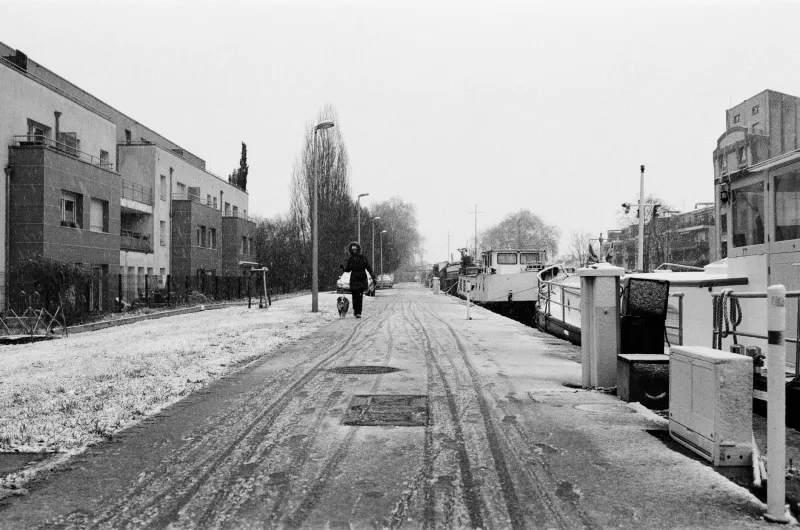
Hard frost turns a familiar walk into a different place. The canal path that was muddy in October is now crisp underfoot, the park lake has a pale skin across it, and your dog has spotted something moving on the other side. That is the moment this article is about. Not the romantic bit with the frosty reeds — the bit where a chase becomes a rescue.
No ice in the UK is reliably safe ice. It does not matter that it held your neighbour's Labrador yesterday or that the shallows look solid. Thickness changes across a pond, a canal is not a still lake, and a dog's weight on four small paws is not the same as yours. The aim is simple: choose routes that keep the decision out of your dog's paws, and have a plan for the day the decision goes wrong.
Route first, recall second
The most effective winter water safety tool is a boring map. Before the first hard frost, look at your usual walks and mark the wet bits: the park lake, the canal towpath, the reservoir edge, the pond behind the allotments, the stream that floods the lower field. Then plan a dry version of each walk. It might mean walking the outside of the park instead of the lakeside loop, taking the housing estate route rather than the towpath, or driving five minutes to a field with no standing water.
This is not about avoiding water forever. It is about not asking a dog to make a sensible choice next to a sheet of ice. A dog who loves a chase is not being naughty when they go for it; they are being a dog. Your job is to make the choice unavailable.
Lead length matters near water. A long line is brilliant for sniffing and recall practice in open fields, but near an icy bank it is a tangle waiting to happen. Use a fixed lead, keep it short, and keep your body between the dog and the water where you can. If your dog wears a harness, use the back handle for close control rather than wrapping the lead around your hand. Never tie a lead to yourself near water. If the dog goes in, you need to be free to help from the bank, not attached to a slipping dog.
Read the ice and the signs
You do not need to become an ice scientist. You need to recognise the obvious no-go signs. Grey or white ice is often weaker than clear ice. Slush on top, cracks radiating from the edge, dark patches, and open water at the margins all say stay back. Snow is worse than it looks because it hides holes and thin patches. Inlets, outflows, bridge shadows and reed beds are usually thinner. A canal can look flat and solid while the water is still moving underneath.
Local signage is there for a reason. Council notices at park gates, Canal & River Trust boards on towpaths, and volunteer group signs around common land often tell you where the ice has been a problem before. Read them, but do not treat the absence of a sign as a guarantee. If a gate is closed or a path is flooded, take the long way round. The extra ten minutes is cheaper than a call to the fire service.
If a dog goes through
The first rule is the one people break: do not follow onto the ice. Not one step. Not to grab the collar. Not because you are lighter than you think. Ice that cannot hold a dog will not hold a person, and an owner in the water turns one emergency into two. Call 999 and ask for fire and rescue. Give the exact location — park name, nearest road, what3words if you have it — and stay on the bank where the dog can see and hear you.
Keep your voice calm. If the dog can swim to the bank and you can stay on solid ground, use a lead, a long stick or a scarf to guide them in, but do not lean out over the edge. Do not send another dog onto the ice. If the dog is out of reach, wait for the emergency services and keep talking. Once the dog is out, wrap them in something dry, get them to a warm car and call your vet. Cold water and hypothermia are serious even if the dog seems fine after a shake-off.
Build the plan before the frost
Save your vet's number and your nearest out-of-hours vet in your phone now. Know the postcode and what3words for your regular waterside walks. Tell someone where you are going on cold mornings. Carry a slip lead and a towel in the car, and keep your phone charged. If a dog walker takes your dog, put water rules in the handover: short lead near ice, no lake loops, call you if anything changes.
The best winter water plan is not dramatic. It is a different route, a shorter lead and a phone number you hope never to use. The long way round is the dry way — and it ends with everyone home.