£15, £25 or £40? What a Dog Walker's Price Tag Actually Tells You in 2026
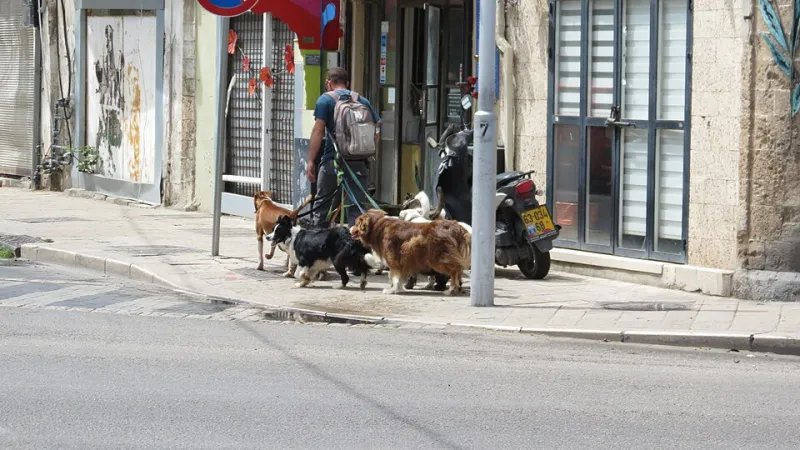
Photo: Hoshvilim, CC BY-SA 4.0, via Wikimedia Commons
Ask four dog walkers in the same town to quote for an hour's walk and you'll get four different numbers. Sometimes you'll get four very different numbers. It's tempting to assume the cheapest is a bargain and the dearest is having a laugh, but neither assumption holds up once you know what goes into the price.
So here's the honest version: what a walk actually costs to run, what you should be asking before you hand over a key, and where the genuine red flags are.
What's baked into the price before anyone clips a lead
A professional walker carries costs whether or not your dog goes out that day.
Insurance. Public liability cover of £1m to £5m is the norm, plus care, custody and control cover for the animals in their charge. That's a few hundred pounds a year, and it should be evidenced with a certificate, not a promise.
Safeguarding checks. A basic or standard DBS check in England and Wales costs a modest amount but takes time, and many walkers subscribe to the update service so clients can verify it stays current. In Scotland it's a PVG scheme check. Ask which one and when it was last refreshed.
Key handling. Keysafes, key-holding services and the admin of logging keys in and out all cost money. A walker with forty sets of keys has a genuine security responsibility.
The vehicle. Fuel, mileage, dog-proofing, crates or guards, and cleaning. If a walker is driving to collect four dogs from four postcodes, that's real money and real time.
Time you don't see. A 60-minute walk is often 60 minutes door to door — ten minutes collecting, forty minutes walking, ten minutes dropping off. Some walkers quote the walking time and charge accordingly. Both are fair, but you should know which you're buying.
The walker's own overheads. Software subscriptions, card fees, accountancy, tax, National Insurance, holiday cover and sick pay. A self-employed walker with no cover is one twisted ankle away from cancelling on you for a fortnight.
The numbers you'll see in 2026
Treat these as broad national ranges rather than a price list. London and the big cities sit at the top; rural areas and the north east sit lower.
- Group walk, 60 minutes, three to six dogs: roughly £13–£20
- Solo walk, 30 minutes: roughly £13–£18
- Solo walk, 60 minutes: roughly £18–£28
- Puppy or welfare visit, 15–30 minutes: roughly £10–£15
- Weekend and bank holiday surcharge: often 10–50%
- Specialist or adventure walks, secure-field sessions, training walks: £25–£40
A walker charging £25 for a solo hour isn't necessarily expensive. A walker charging £12 to take eight dogs to an unfenced common is not a bargain — it's a risk you're paying for with your dog's safety.
The questions worth asking before you book
The price is the easiest thing to compare and the least useful. Everything below tells you more.
- How many dogs will be on my dog's walk, and is that a hard maximum?
- Is the walk door to door or lead-on time?
- Are dogs walked off lead, and if so, where — and what's your recall policy?
- How are dogs transported, and are they crated or separated?
- Can I see your insurance certificate and DBS or PVG check?
- Who actually walks my dog, and do you ever send a subcontractor?
- What's your emergency vet protocol, and can I see the consent form?
- Which vet do you use out of hours, and who authorises treatment and payment?
- What's your cancellation policy — for me, and for you?
- How are keys stored, who else has access, and how is my data handled?
- Will you send photos or a message after each walk?
- What happens if my dog is unwell, lame, or in season?
A good walker will answer all twelve without flinching. Some will have it all written down already.
Red flags that should make you pause
- No written contract or terms, just a WhatsApp agreement
- Claims of insurance but no certificate forthcoming
- Cash only, no receipt, no company name or address
- Dogs loose in the boot or on the back seat with no restraint
- Groups that quietly grow well beyond what was quoted
- No meet-and-greet, or a meet-and-greet that lasts ninety seconds in a car park
- Full payment demanded months in advance
- Vague answers about emergency vet arrangements
- A walker who won't say who'll be holding your key
- Off-lead walking in open areas with dogs who clearly have no recall
Emergency protocols deserve their own conversation
This is the bit owners skip and later wish they hadn't. Ask directly: if my dog is injured two miles from home, what happens in the first ten minutes? Who do you ring? Do you have my vet's details and an out-of-hours number in your phone? Is there a signed consent form allowing treatment up to a stated amount, and who pays the bill?
Check your own pet insurance too. Most policies cover emergency treatment, but you'll usually pay upfront and claim back, so agree in advance how that's handled.
Read the cancellation terms properly
A fair policy cuts both ways. Look for clear notice periods, a weather clause (ice and heat both stop walks), a policy for walker illness or holiday, and a clear statement on whether bank holidays are charged. If a walker cancels on you, you shouldn't be paying. If you cancel with two hours' notice on a busy Saturday, it's reasonable that you might.
Our view on fair pricing
Fair pricing is transparent pricing. A walker who tells you exactly what a 60-minute walk includes, what extras cost, what happens when they're ill, and what they'll do in an emergency is worth more than the number on the invoice suggests. Conversely, a suspiciously cheap walk is usually being subsidised by something — group size, travel time, insurance, or the walker's own income.
Pay for clarity. If two quotes are close, choose the walker who answered your questions properly, did a proper handover, and made your dog look pleased to see them. That's the one you'll still be using in three years.